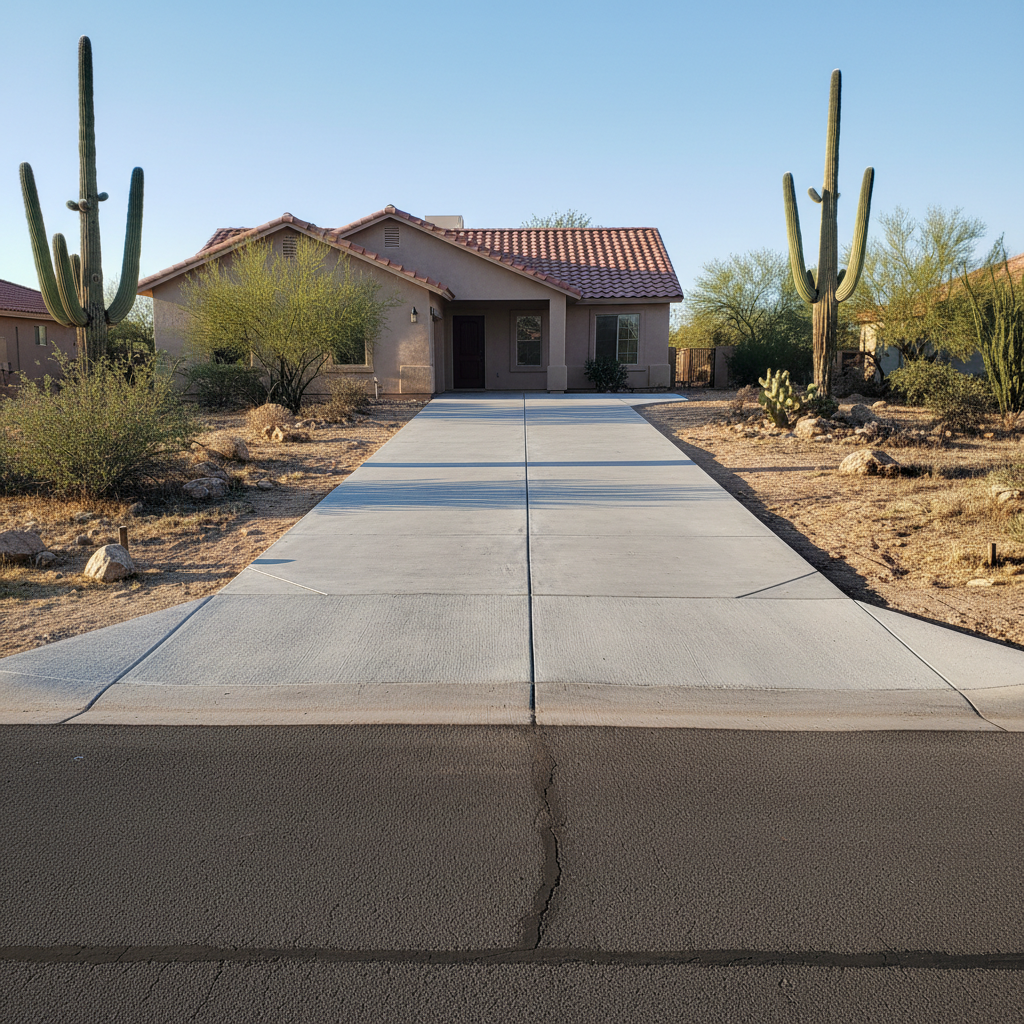
Concrete doesn't give you a second chance. Once it's poured and cured you're not repainting a mistake, you're renting a jackhammer. That's what makes picking the right contractor harder than picking a painter or a landscaper. You can't see the base prep, the rebar placement, or the mix design after the fact. You just see a slab that either holds up for thirty years or starts cracking in two.
In Marana the ground and the weather both work against sloppy work in ways that don't show up on a bid sheet. Here's what actually separates a contractor worth hiring from one you should walk away from.
What the caliche under your lot does to a bad pour
A lot of Marana soil sits on caliche, a hardpan layer of calcium carbonate that can run anywhere from a few inches to several feet thick. It's basically natural concrete already. Water doesn't soak through it, it sits on top of it. If a crew pours a slab straight onto caliche without breaking through it and laying down 4 to 6 inches of compacted aggregate base, water has nowhere to go after a storm. It pools under the slab, the ground underneath shifts as it dries out again, and you get cracking and settling within a couple of years.
Breaking through caliche takes longer and is harder on equipment than digging through regular dirt. Some contractors skip it, or scrape the surface and call it prepped. Ask directly how they're handling sub-base prep and whether they've hit caliche on other jobs in your neighborhood. A contractor who's worked Marana for any length of time will have an answer ready, not a shrug.
Pouring in June and pouring in monsoon season are two different jobs
Summer in Marana means 100-plus degree days for weeks at a stretch, and concrete doesn't care that you'd rather not be outside in it. In that heat, the surface of a slab can skin over and start setting before the crew has finished finishing it, while the concrete underneath is still wet. That mismatch is where you get surface crazing and scaling later. A crew that knows what it's doing pours early, before sunrise if the job's big enough, uses a retarding admixture to slow the set, and keeps the slab damp with curing blankets or a sprayed curing compound for at least 3 to 7 days afterward.
Then there's monsoon season, roughly July through September. The storms here come up fast in the afternoon and dump a lot of water in a short time. A slab poured that morning and left uncovered when a storm rolls through gets pitted and discolored on the surface, sometimes bad enough to need grinding or a topping. Ask any contractor how they handle the schedule during monsoon weeks. If the answer is 'we just go for it,' that's a problem you'll be looking at for years.
Licenses, permits, and who actually signs off on the work
Any contractor pouring concrete in Arizona should carry an active license through the Arizona Registrar of Contractors. Ask for the number and look it up yourself, it takes two minutes. Don't take a business card's word for it.
Permitting depends on what you're building and where your lot sits. A driveway apron that connects to the public street usually needs sign-off from the Town of Marana's engineering side, since it touches the right-of-way. A new slab foundation or a structural addition will go through inspection at the footing and reinforcement stage before the pour, and again after. If your property is in one of the unincorporated county pockets near Avra Valley, it's Pima County running the inspections instead of the Town. And if you're in a newer subdivision like Dove Mountain, Gladden Farms, or Continental Ranch, there's a good chance your HOA wants to review the plan before you even file for a permit. A contractor who's done work in your specific neighborhood will already know which of these apply. One who's never heard of your HOA is guessing right along with you.
What should actually be in the bid
A real bid tells you the slab thickness, not just a price per square foot. A standard driveway or patio runs 4 inches thick. An RV pad or a garage slab that'll carry a vehicle's full weight should be closer to 5 or 6 inches, with thicker edges where the load concentrates.
It should also say how the slab is reinforced. Wire mesh is common and cheap, but it has a habit of sinking to the bottom of the pour if nobody pulls it up as they go, which means it ends up doing nothing. Rebar set on chairs holds its position through the pour and does the job mesh is supposed to do. Ask which one you're getting and why.
Control joints matter more than most homeowners realize. Concrete is going to crack somewhere as it shrinks while curing, the only question is where. Cutting control joints 1 to 2 inches deep within 24 to 48 hours of the pour gives the crack a place to go on purpose instead of running wherever it wants across your new patio. As a rough rule, joint spacing in feet should be about two to three times the slab thickness in inches, so a 4 inch slab gets joints roughly every 8 to 10 feet. If a bid doesn't mention any of this, you're buying a guess, not a spec.
Signs to walk away from
Cash only, no written contract, and pressure to sign today because the price is only good today. All three of those together is close to a guarantee of trouble. So is a contractor who can't tell you straight whether they'll be running the mixer truck and finishing the slab themselves or subbing the whole job out to someone you've never spoken to.
A low bid that's thousands under everyone else almost always means something is getting skipped, usually the base prep, since it's invisible once the slab goes down. Ask every bidder the same questions about sub-base, thickness, reinforcement, and curing time, and compare the answers, not just the number at the bottom.
We've poured plenty of driveways, patios, and slabs across Marana and dealt with the caliche, the heat, and the monsoon timing that comes with it. If you want a bid that spells out thickness, base prep, and reinforcement before you sign anything, take a look at Pinnacle Concrete.